
Feature requests
A built-in request board, exposed inside your app and at a shareable public roadmap URL. Users submit, vote and comment; you triage status; everyone sees what's shipping.
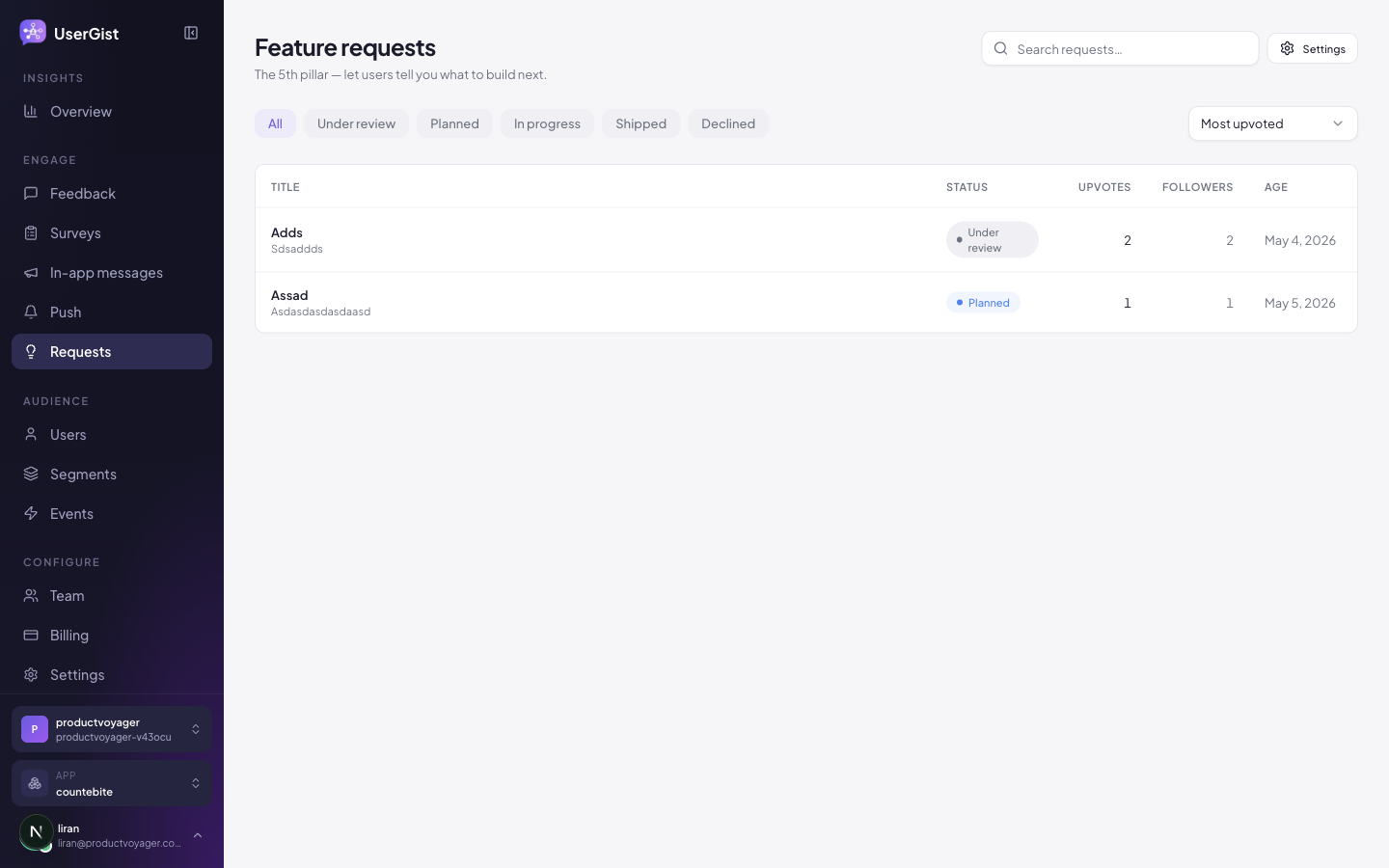
Feature requests doesn't use the four-stage composer the other channels do. It's configured once under Requests → Settings, then you live in two places: the public roadmap (your users) and the triage board (your team).
Configuration
The single configuration form has six sections. Each option below is what you'll see in the dashboard.
Entry
| Field | Notes |
|---|---|
enabled | Master toggle. When off, the SDK board doesn't render and submitRequest rejects with disabled. |
entryLabel | The string shown on your in-app entry point (1–60 chars). Default: Feature requests. |
Permissions — who can do what
Two segments gate access:
| Field | Notes |
|---|---|
viewSegmentId | Segment of users who can view the board. Leave empty to allow everyone. |
submitSegmentId | Segment of users who can submit new requests. Typically narrower than view — e.g. only paying users can submit. |
Use this to keep the request board signal high. Only Pro users can submit; everyone can view and vote.
Public roadmap
| Field | Notes |
|---|---|
publicRoadmapEnabled | When on, exposes https://roadmap.usergist.com/<slug> and /v1/public/roadmap/<slug> for custom read-only clients. |
publicSlug | 3–48 chars, lowercase + hyphens + digits. The URL component. |
Branding
| Field | Notes |
|---|---|
logoUrl | Shown on the public roadmap header. |
accentColor | Hex #rrggbb. Active states and upvote highlights. |
coverImageUrl | Hero image at the top of the public page. |
introCopy | Up to 500 chars. Markdown supported. The text that sits under the cover. |
Notification rules
Triage actions can notify followers automatically.
| Rule | Triggers when |
|---|---|
transitions | A request's status changes — fires per transition (e.g. under_review → planned). |
responseFirst | First admin response is posted. |
responseEdit | Admin edits an existing response. |
templateOverrides | Per-status copy overrides for the outgoing notification body. |
Notifications flow over in-app + push if the follower has consented to those channels.
Triage board
The board is where your team works. Three views:
- Kanban — grouped by status, drag-and-drop between columns.
- Table — sortable + filterable list.
- Detail — full request thread with comments.
Sort
| Value | Notes |
|---|---|
top | Highest vote count first. |
newest | Most recently submitted. |
recently_updated | Most recent triage activity (status change, response, comment). |
Filters
- Status — multi-select across
under_review,planned,in_progress,shipped,declined. - Personal filter —
submitted(by me) ·upvoted·following. - Hidden — show requests admin-hidden for moderation.
- Search — debounced (300 ms) across title + body.
Statuses
| Status | Default order | Meaning |
|---|---|---|
under_review | 1 | Open for discussion; no commitment. |
planned | 2 | On the roadmap. We will build this. |
in_progress | 3 | Active development. |
shipped | 4 | Live. Followers are notified. |
declined | 5 | Won't build. Followers are notified with the reason. |
Bulk operations
Select multiple cards to:
- Change status (up to 200 at once).
- Merge — pick a canonical + duplicates. Votes and followers transfer; comments preserve.
Developer responses and hide / unhide moderation are available on an individual request.
In-app surface
Two ways your app talks to requests:
// Hosted UI (recommended) — UserGist renders the full board
UserGist.openRequestsBoard()
UserGist.openRequestDetail('req_abc123')

// Or build your own UI on the data APIs
const { items } = await UserGist.getRequests({ statuses: ['planned'], q: 'dark' })
await UserGist.voteOnRequest('req_abc123', true)
await UserGist.followRequest('req_abc123', true)
UserGist.submitRequest('Dark mode', 'A system-aware theme would help.', (error, request) => {
  if (error) console.error(error)
})

const comments = await UserGist.getComments('req_abc123')
await UserGist.postComment('req_abc123', 'Yes please.')
Optimistic semantics (identical on every SDK):
- Voting auto-follows the request.
- Un-voting does not unfollow.
- Vote / follow tap updates the UI immediately and reconciles with the server.
Public roadmap
Once publicRoadmapEnabled is on, three URLs are live:
https://roadmap.usergist.com/<slug>— branded HTML page.https://roadmap.usergist.com/<slug>?embed=1— chrome-free version for iframe embedding.GET /v1/public/roadmap/<slug>— JSON for custom integrations.
See Guides → Embed the public roadmap.
Closing the loop
When an operator changes status or posts a developer response, UserGist's request notification service applies the configured transition/response rules and notifies followers over their eligible in-app and push channels.
API
GET /v1/apps/:appId/requests— list (admin)POST /v1/sdk/requests— SDK submissionPATCH /v1/apps/:appId/requests/:requestId/status— change statusPATCH /v1/apps/:appId/requests/:requestId/moderation— hide or unhidePOST /v1/apps/:appId/requests/merge— merge duplicatesGET /v1/public/roadmap/:slug— public roadmap data
Comment, vote, and follow endpoints all under the same family. Canonical schemas: apps/api/src/schemas/requests.ts.
What's next
- Guides → Embed the public roadmap
- SDKs → React Native
- Features → Push — notify on
shipped
Feature requests on websites
Use the Web SDK to open the request board or a request detail, submit ideas, vote, follow and manage comments. Participation requires explicit activation and feedback consent. The launcher is optional and off by default.
Mutations can return { queued: true, pendingId } while waiting for connectivity or earlier pending work. Treat that as saved locally instead of submitting again. The SDK sends retries and newer actions in order. Loading the board and opening request details require a connection. Browser notification push is not included.